Understanding the Importance of Visual Storytelling


Visual storytelling is reshaping how we connect and share big ideas. People process images 60,000 times faster than text, which flips traditional communication on its head. Sounds like the secret is all about flashy looks and cool graphics. But the real magic lies in how visual stories trigger deep emotional responses and create lasting memories you cannot get from words alone.
Table of Contents
Quick Summary
Takeaway | Explanation |
Visual storytelling enhances audience engagement | By using imagery and narrative techniques, visual storytelling transforms passive viewing into an interactive experience, fostering deeper connections with audiences. |
Humans process visuals faster than text | Research indicates that visuals can be processed 60,000 times quicker than text, leading to quicker comprehension and memory retention during communication. |
Emotional resonance is key to impact | Effective visual narratives evoke emotions through color, composition, and storytelling, facilitating a stronger connection with the audience. |
Understanding design principles is essential | Mastery of visual design elements—like color psychology and layout—enhances the effectiveness of the narrative delivered through visuals. |
Visual storytelling serves numerous sectors | From marketing to education, visual storytelling is adaptable, making it a vital tool for communicating complex ideas across various industries. |
The Concept of Visual Storytelling and Its Elements
Visual storytelling transforms communication by leveraging imagery, graphics, and narrative techniques to convey complex messages more powerfully than text alone. At its core, visual storytelling represents a strategic approach to communication that connects audiences through compelling visual narratives.
Understanding Visual Narrative Construction
Visual storytelling combines multiple elements to create meaningful experiences. Research from ResearchGate highlights that effective visual narratives integrate several key components:
Visual composition and design
Emotional engagement strategies
Clear narrative progression
Strategic use of color and imagery
These components work together to transform passive observation into active audience participation. By carefully selecting and arranging visual elements, storytellers can guide viewers through an intentional emotional journey that resonates deeply.
To help clarify the core components of effective visual storytelling, the following table defines each essential element and its specific purpose within the visual narrative process.
Element | Definition | Purpose |
Visual Composition & Design | The arrangement of images, graphics, and layout in storytelling | Guides attention and creates visual hierarchy |
Emotional Engagement Strategies | Techniques to elicit emotional responses from the audience | Fosters stronger connections and enhances message retention |
Narrative Progression | The logical flow and sequence of the story elements | Leads audiences through the narrative journey |
Strategic Use of Color & Imagery | Careful selection of colors and images to reinforce messages | Evokes specific emotions and sets the tone |
Psychological Triggers | Application of psychological principles in visuals | Increases engagement and transcends language barriers |
Elements of Powerful Visual Communication
Successful visual storytelling requires understanding fundamental design principles and psychological triggers. Professionals must consider how each visual element contributes to the overall narrative. Color psychology plays a significant role, with specific hues capable of evoking distinct emotional responses. Composition techniques like framing, perspective, and balance help direct viewer attention and create visual hierarchy.
The goal is not merely aesthetic appeal but creating a narrative framework that communicates complex ideas efficiently. Read more about our approach to audiovisual storytelling, where we transform abstract concepts into compelling visual experiences that connect with audiences on a profound level.
Psychological Impact of Visual Narratives
Beyond aesthetic considerations, visual storytelling operates on deep psychological principles. Humans process visual information exponentially faster than text, making images a potent communication tool. When designed thoughtfully, visual narratives can transcend language barriers, communicate nuanced emotions, and create immediate intellectual and emotional connections with viewers.
By understanding these fundamental principles, organizations and communicators can leverage visual storytelling as a powerful strategy for engagement, education, and persuasion.
The Significance of Visual Storytelling in Communication
Visual storytelling transcends traditional communication methods by creating powerful, immediate connections between messages and audiences. This transformative approach leverages human cognitive processes to deliver information more effectively and memorably.
Cognitive Processing and Information Retention
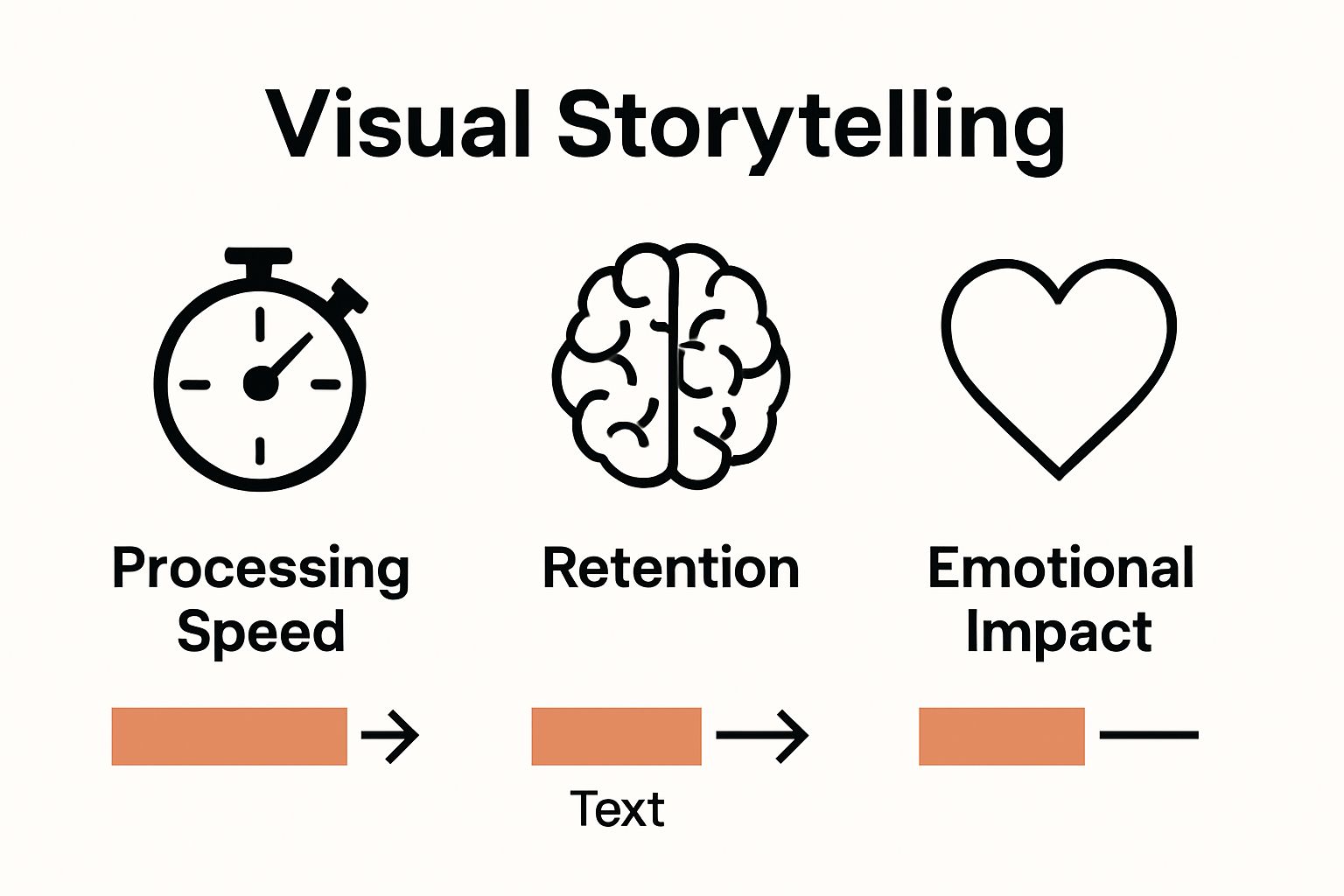
Research from the National Institutes of Health reveals that humans process visual information 60,000 times faster than text, making visual storytelling an incredibly potent communication strategy. Key advantages include:
Faster comprehension of complex concepts
Improved information retention
Enhanced emotional engagement
Universal communication potential across language barriers
By tapping into our brain’s natural visual processing capabilities, storytellers can communicate intricate ideas with remarkable efficiency and clarity.
Emotional Impact and Audience Connection
Beyond cognitive processing, visual storytelling creates profound emotional resonance. Images and narrative sequences trigger neurological responses that text alone cannot achieve. Color, composition, and visual metaphors activate multiple sensory and emotional centers in the brain, enabling deeper audience understanding and connection.
Learn more about our storytelling strategies, where we transform complex communication challenges into compelling visual narratives that inspire and inform.
Strategic Communication Across Domains
Visual storytelling has become a critical communication tool across diverse sectors. From marketing and education to healthcare and social advocacy, organizations recognize its power to simplify complex messages, evoke empathy, and drive meaningful engagement. Professionals use visual narratives to break down barriers, communicate global issues, and create shared understanding in an increasingly visual and digital world.
By understanding and implementing visual storytelling principles, communicators can create more impactful, memorable, and transformative messages that resonate deeply with their intended audiences.
How Visual Storytelling Engages and Captivates Audiences
Visual storytelling represents a sophisticated communication approach that transforms passive viewing into an immersive, emotionally compelling experience. By strategically blending narrative techniques with visual elements, communicators can create powerful connections that transcend traditional information delivery methods.
Neurological Engagement Mechanisms
Research from Frontiers in Psychology reveals that visual narratives activate multiple brain regions simultaneously, generating complex neurological responses that text alone cannot achieve. This multisensory engagement creates profound audience experiences through:
Immediate emotional resonance
Enhanced memory formation
Deeper contextual understanding
Increased psychological investment
These neurological triggers transform audience interaction from mere observation to active psychological participation, making visual stories inherently more engaging than traditional communication methods.
Psychological Connection and Narrative Dynamics
Successful visual storytelling operates on intricate psychological principles. By constructing narratives that mirror human emotional experiences, communicators can create immediate empathy and connection. Visual metaphors, strategic color choices, and dynamic composition work together to guide audience emotions and perceptions.
Learn more about our storytelling approach, where we craft narratives that speak directly to viewers’ subconscious emotional landscapes.
Audience Interaction and Immersive Experiences
Modern audiences crave experiences that feel personalized and authentic. Visual storytelling meets this demand by creating immersive narratives that invite viewers into complex emotional journeys. Through carefully constructed visual sequences, storytellers can communicate nuanced messages that resonate on intellectual and emotional levels.
By understanding and implementing these sophisticated engagement strategies, communicators can transform information delivery into compelling, memorable experiences that truly connect with their audiences.
Real-World Applications of Visual Storytelling in Business
Visual storytelling has emerged as a transformative strategy for businesses seeking to communicate complex messages, build brand identity, and create meaningful connections with their target audiences. By leveraging sophisticated visual narrative techniques, organizations can transcend traditional marketing approaches and establish more profound engagement.
Brand Communication and Marketing Strategies
Marketing Research Reports demonstrate that companies utilizing visual storytelling experience significantly higher audience engagement and brand recall. Key strategic applications include:
Creating compelling brand narratives
Simplifying complex product explanations
Humanizing corporate communication
Generating emotional customer connections
These visual communication strategies enable businesses to transform mundane information into compelling, memorable experiences that resonate with consumers on multiple levels.
Product Explanation and Customer Education
Visual storytelling serves as a powerful tool for explaining intricate products and services.
By breaking down complex concepts through carefully crafted visual narratives, businesses can help customers understand value propositions more effectively. Infographics, animated explainer videos, and interactive visual content allow organizations to communicate technical information in accessible, engaging formats.
Explore our approach to corporate storytelling, where we transform complex business messages into compelling visual narratives that drive understanding and engagement.
Organizational Culture and Internal Communication
Beyond external marketing, visual storytelling plays a crucial role in internal organizational communication. Companies use visual narratives to articulate corporate values, document organizational history, and create cohesive team experiences. By presenting internal stories through sophisticated visual techniques, businesses can foster stronger employee connections, communicate strategic objectives, and build a more unified organizational culture.
The strategic implementation of visual storytelling represents a sophisticated approach to business communication, enabling organizations to communicate more effectively, build stronger relationships, and differentiate themselves in competitive markets.
Below is a table summarizing real-world business applications of visual storytelling and the key benefits each area gains from strategic use of visual narratives.
Application Area | Business Benefit |
Brand Communication & Marketing | Higher engagement and stronger brand recall |
Product Explanation & Customer Education | Easier understanding of complex products/services |
Organizational Culture & Internal Communication | Stronger employee connection and unified culture |
Emotional Customer Connections | Increased loyalty and attachment to brands |
Simplifying Technical Information | Enhanced accessibility and audience reach |

Key Principles for Effective Visual Storytelling
Mastering visual storytelling requires understanding sophisticated design principles that transform raw visual content into compelling narrative experiences. Successful storytellers blend technical skills, psychological insights, and creative vision to create memorable communication strategies.
Narrative Structure and Emotional Architecture
Narrative Design Research reveals that effective visual storytelling demands a deliberate narrative architecture that guides audience emotional engagement. Critical components include:
Clear narrative progression
Intentional emotional trajectory
Strategic visual sequencing
Authentic character development
These foundational elements ensure that visual stories transcend mere aesthetic presentation and create meaningful audience connections.
Design Principles and Visual Language
Compelling visual storytelling relies on mastering fundamental design principles that communicate meaning beyond literal representation. Color psychology, compositional balance, visual hierarchy, and strategic visual metaphors work together to create nuanced communication experiences. Professionals must understand how visual elements interact to guide viewer perception and emotional response.
Explore our comprehensive storytelling strategies, where we decode the intricate language of visual communication.
Audience-Centric Storytelling Approach
The most powerful visual narratives are constructed with deep audience understanding. This requires extensive research into viewer demographics, psychological triggers, cultural contexts, and emotional landscapes. Successful storytellers create flexible visual languages that can adapt to diverse audience expectations while maintaining a consistent core narrative.
By integrating these sophisticated principles, visual storytellers can create communication experiences that are not just seen, but deeply felt and remembered.
Bring Your Visual Story to Life with Tulip Films
Are you struggling to break through the noise and capture real attention with your message? As highlighted in our deep dive into visual storytelling, many brands and organizations face the challenge of turning complex ideas into clear, memorable narratives. Too often, audiences tune out when messages lack emotional appeal or compelling visuals. If you need to create that instant emotional connection and lasting impact described in the article, you need experts who understand not just how to tell a story, but how to craft a narrative that truly resonates. See how our audiovisual storytelling approach transforms abstract concepts into striking visuals audiences remember.

Ready to move beyond ordinary communication and elevate your brand’s message? Let Tulip Films help you engage, educate, and inspire with high-quality, tailored video solutions. Explore real examples and discover how our storytelling strategies can work for you. Take your first step toward more impactful communication today by visiting www.tulipfilms.ch to schedule your free consultation and start building stronger connections with your audience now.
Frequently Asked Questions
What is visual storytelling?
Visual storytelling is a communication method that uses imagery, graphics, and narrative techniques to convey messages more powerfully than text alone, creating compelling connections with audiences.
How does visual storytelling enhance information retention?
Studies show that humans process visual information significantly faster than text, leading to improved comprehension and memory retention, which makes visual storytelling an effective means to communicate complex ideas.
What elements are essential for effective visual storytelling?
Key elements include visual composition and design, emotional engagement strategies, clear narrative progression, and the strategic use of color and imagery to create a meaningful experience for the audience.
Why is emotional engagement important in visual storytelling?
Emotional engagement is crucial as it activates neurological responses and helps build immediate connections with viewers, leading to a deeper understanding and retention of the message being conveyed.
Recommended
