What Is a Corporate Town Hall Video? A 2026 Guide


TL;DR:
A corporate town hall video is a broadcast-style event where leadership communicates organizational updates with moderated interaction and multimedia elements.
Its design ensures control at scale, differentiating it from regular video calls through structured architecture and technical preparation.
Most communication professionals assume a corporate town hall video is just a large video call. It’s not. A corporate town hall video is a structured, often broadcast-style event where senior leadership addresses the entire organization, integrates multimedia, and manages real-time employee interaction through moderated tools. The format exists specifically because standard video conferences break down at scale. Understanding what is corporate town hall video means recognizing it as a distinct communication vehicle with its own technical requirements, engagement mechanics, and strategic purpose. This guide covers the format, benefits, production requirements, and practical execution.
Table of Contents
Key takeaways
Point | Details |
Not just a big video call | Corporate town halls use broadcast architecture with moderated Q&A, not open microphones for all attendees. |
Leadership drives the format | CEO or senior leadership presentations anchored by department updates define the classic town hall structure. |
Scale requires technical prep | Network optimization, platform selection, and bandwidth planning directly determine event quality. |
Recorded content extends reach | On-demand video packages with captions multiply impact well beyond the live session. |
Production quality signals credibility | Poor audio and video undermine leadership messages, regardless of content strength. |
What is a corporate town hall video, exactly
The corporate town hall definition is straightforward: it is a company-wide video session where leadership communicates organizational updates, strategy, and priorities to all employees at once. Town hall format opens with senior leadership presenting key topics, followed by department updates and a Q&A segment where employees submit questions through moderated channels.
What separates this format from a regular video meeting is the architecture. In a standard video call, every participant has audio and video access. In a town hall video, the model flips entirely. Dozens to hundreds of attendees receive a broadcast-style stream while interacting through polls, chat, and submitted questions rather than open microphones. This is not a workaround. It is a deliberate design choice that maintains control and ensures a coherent experience at scale.
The core components of a town hall video format typically include:
CEO or senior leadership opening with strategic updates and company performance context
Department or business unit presentations providing operational detail
Live Q&A segment managed by a moderator who filters and routes employee questions
Live polls to gauge sentiment or gather quick feedback in real time
Recorded video segments embedded for context, such as customer testimonials or product previews
The distinction from a webinar matters too. Webinars are often external-facing and marketing-oriented. Town hall videos are internal, culture-driven, and tied to organizational trust.
Pro Tip: Run a 15-minute technical rehearsal with all presenters 48 hours before the event, not the morning of. This surfaces platform issues, connection problems, and slide-sharing conflicts while there is still time to fix them.
For communication professionals working on planning effective corporate video formats, understanding this architectural difference is the single most important insight you can carry into any town hall production.
Why town hall videos matter for engagement
The benefits of town hall videos go beyond information delivery. They function as a trust mechanism between leadership and employees. Town halls provide a direct channel for leadership to share updates and address employee feedback in real time, creating a two-way communication flow that email chains and slide decks cannot replicate.
Transparency is the most cited benefit, but the real value is perceived access to leadership. When employees see the CEO answer unscripted questions on camera, that visibility builds credibility in ways that polished newsletters never do.
“The most effective town halls are not the ones with the best production budgets. They are the ones where employees leave believing leadership actually heard them.”
Here is what the format delivers when executed well:
Organizational alignment: Every employee hears the same strategic message at the same time, eliminating the distortion that happens when information travels through management layers.
Inclusivity for distributed teams: Hybrid digital formats let remote and in-office employees participate simultaneously, preventing the two-tier communication problem common in distributed organizations.
Ongoing engagement through recordings: Captions and on-demand video extend the event’s reach to employees in different time zones or those who could not attend live, without losing the message.
Cultural reinforcement: Consistent town hall cadence signals that leadership values transparency, which compounds over time into stronger organizational culture.
The engagement dynamic also changes when employees know they can submit questions. Participation becomes active rather than passive, even in an audience of a thousand. That psychological shift matters more than most communication teams realize.
Technical requirements for a smooth delivery
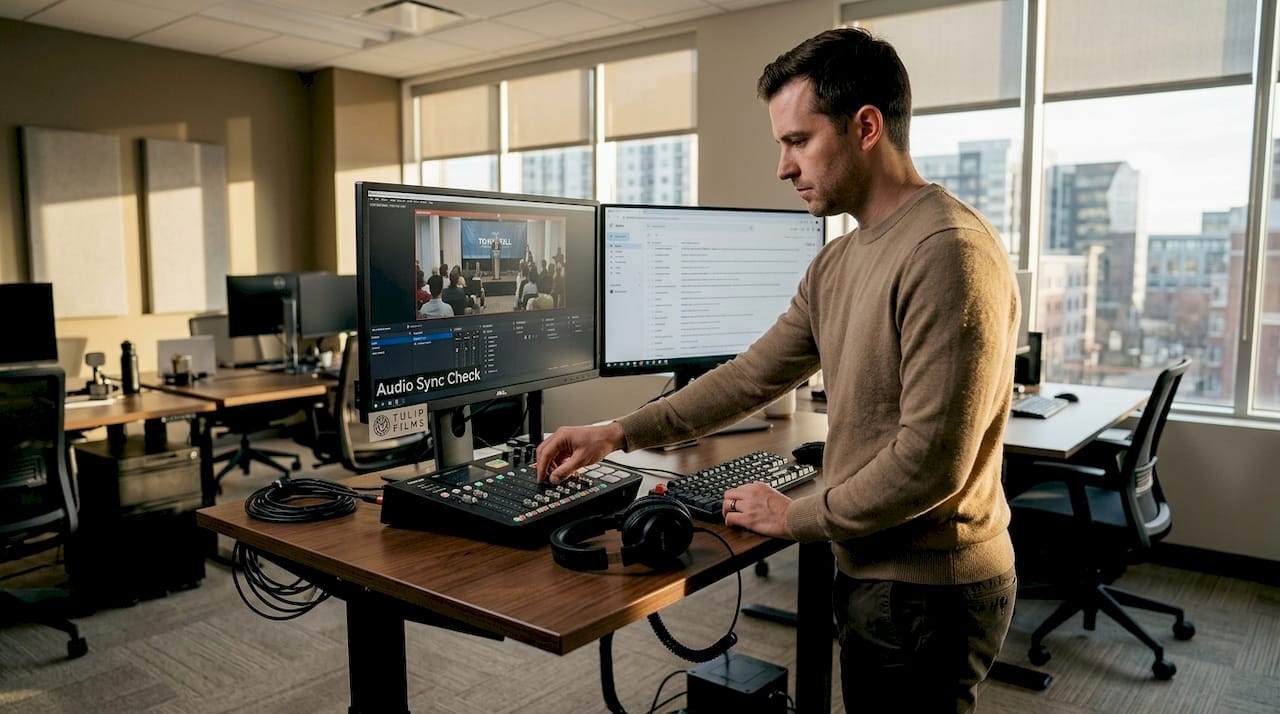
Production quality determines whether your message lands. A shaky feed, audio dropout, or crashed Q&A tool does not just cause inconvenience. It signals disorganization at the leadership level. Here is what actually needs to work.
Platform and network considerations
Microsoft Teams town hall features are built for this exact use case. Bandwidth requirements run approximately 2 to 3 Mbps per viewer, and for organizations with hundreds of concurrent viewers on a shared network, this compounds quickly. Enterprise Content Delivery Networks, known as eCDN, solve this by distributing the stream across local network peers rather than routing all traffic through a central server.
The table below shows key technical variables and what to prioritize at each audience scale:
Audience size | Platform recommendation | Key technical priority |
Under 100 attendees | Microsoft Teams, Zoom Webinar | Stable presenter connection |
100 to 500 attendees | Microsoft Teams Town Hall, Vimeo Live | eCDN setup, bandwidth testing |
500 to 5,000+ attendees | Dedicated streaming platforms | Full eCDN deployment, redundant feeds |
Managing interaction at scale
Disabling attendee audio and video while routing all engagement through moderated Q&A and chat prevents the session from devolving into noise. This is not a limitation. It is the defining feature of the town hall interaction model, where many attendees interact through limited, moderated channels rather than open participation.
Practical steps for technical execution:
Test your streaming platform with a full load simulation at least one week before the event.
Assign a dedicated technical producer separate from the moderator to monitor stream health in real time.
Enable captions by default, not as an afterthought. Accessibility is not optional for organizations serious about inclusion.
Pre-record high-production segments such as testimonials or video explainers to reduce live production risk during the session.
Prepare a contingency plan for stream failure that includes a backup dial-in number and a communication protocol to notify attendees within two minutes.
Pro Tip: Assign one team member exclusively to monitor the Q&A queue throughout the session. Questions that get ignored publicly are worse than not having a Q&A at all. Employees notice.
How to create town hall videos that drive participation
Knowing how to create town hall videos that actually generate engagement comes down to structure, pacing, and follow-through. Many organizations invest in the production and ignore the planning. That is where execution falls apart.
Start with the agenda architecture. A well-structured town hall balances executive communication with employee voice. A session running longer than 75 minutes loses audience attention sharply. Keep leadership presentations tight, ideally under 20 minutes total, and protect time for Q&A because that segment is where employees decide whether the event was worth attending.
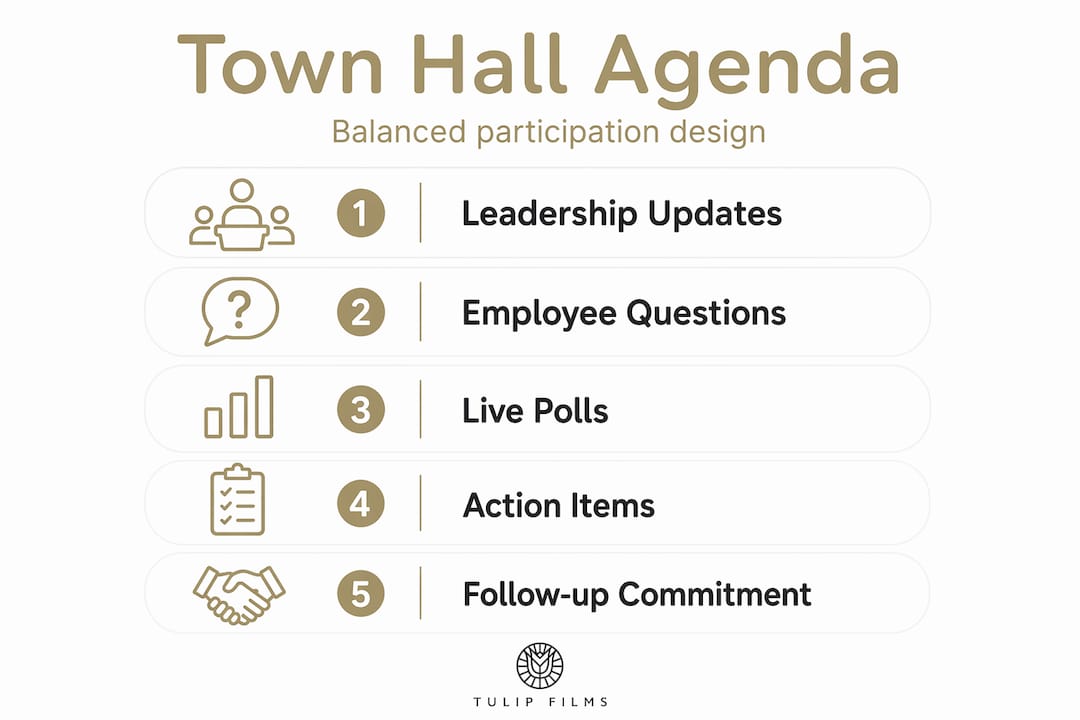
Use multimedia intentionally. Digital bulletin boards and live poll results keep participants focused during transitions and give visual texture to otherwise talk-heavy content. A live poll asking employees to rate their understanding of a new strategy gives leadership real-time data and gives attendees a reason to stay engaged.
For audience engagement techniques that work beyond the event itself, well-planned video engagement strategies can help you think through how to extend participation before, during, and after the broadcast.
Key practices that move the needle:
Send a pre-event question form 48 hours before the session. Employees engage more when they have submitted a question, and leadership can prepare more substantive answers.
Open with context, not logistics. The first two minutes set the tone. Lead with the business situation, not housekeeping announcements.
Assign a visible moderator on camera. This signals that the Q&A is live and human-managed, not filtered by an algorithm.
Publish a recording within 24 hours with indexed chapters so employees can navigate directly to sections relevant to their team.
Follow up with a summary document or short recap video that distills the three or four key commitments made during the session.
The follow-through piece is where most organizations leave value on the table. A town hall that produces zero visible action items is remembered as performative. One that generates documented commitments and visible follow-up builds genuine organizational trust over time.
Pro Tip: End every town hall with one specific commitment from leadership tied to a named date. “We will update you on this by March 15” is worth more to employee trust than ten minutes of inspiring messaging.
My perspective on what most town halls get wrong
I’ve worked with organizations that spent significant budgets on multi-camera setups, branded graphics, and professional lighting for their town hall videos, and then watched employees disengage within the first ten minutes. In my experience, the production value conversation distracts teams from the harder problem: what leadership actually says, and whether employees believe it.
What I’ve seen consistently is that authenticity outperforms polish when they conflict. A CEO answering a tough question with visible honesty, even on a modest setup, does more for organizational trust than a perfectly produced non-answer delivered in 4K. That does not mean production quality is irrelevant. Poor audio is genuinely disqualifying. But production quality has a ceiling effect. Beyond “professional enough,” more investment in gear returns less than investment in preparation and message substance.
The other underrated factor is strategic follow-through. Town halls that generate no visible follow-up action are not just wasted opportunities. They actively damage engagement because they signal that leadership treats communication as a performance rather than a genuine exchange. I’ve seen that dynamic play out at organizations of every size, and it is consistently more damaging than any technical failure.
My recommendation: treat the 30 days after a town hall as seriously as the event itself. The recording, the recap, the documented commitments, and the manager-level follow-up conversations are where effective corporate communication actually happens.
— Pieter
Let Tulipfilms handle your next town hall production
If you are ready to move from planning to execution, Tulipfilms produces corporate event and town hall videos for Swiss organizations that need more than a basic stream. The team specializes in producing content that balances professional quality with authentic leadership communication, whether that is a full multi-camera town hall setup or a polished recorded segment to anchor your next all-hands session.
[
You can review the range of corporate event productions in the Tulipfilms video portfolio to get a concrete sense of the visual quality and formats available. For organizations planning a live or hybrid town hall event, the corporate event videography services page covers what Tulipfilms offers specifically for large-format internal events. Reach out directly to discuss your communication goals and get a tailored quote for your production.
FAQ
What is a corporate town hall video?
A corporate town hall video is a company-wide broadcast where senior leadership presents organizational updates, strategy, and key announcements to all employees, incorporating moderated Q&A and interactive elements. It differs from standard video calls by using a broadcast model with structured interactivity rather than open participation.
How is a town hall video different from a regular video meeting?
In a town hall video, attendee audio and video are disabled and interaction flows through moderated Q&A and polls, while a small group of presenters leads the session. Regular video meetings allow open participation from all attendees, which becomes unmanageable at scale.
What platforms work best for hosting corporate town hall videos?
Microsoft Teams and Vimeo Live are widely used options, with Microsoft Teams offering native town hall functionality including moderated Q&A and eCDN support for large enterprise audiences. Platform choice should be driven by audience size and existing IT infrastructure.
How long should a corporate town hall video be?
Most effective town halls run between 45 and 75 minutes. Keeping leadership presentations under 20 minutes total and reserving dedicated time for Q&A produces the strongest engagement outcomes and prevents audience attrition.
Do town hall videos need professional production support?
Audio quality and visual stability are non-negotiable at any audience size because poor technical delivery undermines leadership credibility. For large-scale or externally visible events, working with a professional video production team significantly reduces technical risk and improves the overall employee experience.
Recommended
