Defining Cinematic Video Style: Authentic Engagement

TL;DR:
Authentic cinematic style relies on deliberate in-camera choices, not post-production filters or LUTs.
Core elements include purposeful lighting, environmental integration, and story-driven camera work.
Building a consistent visual language involves strategic planning, local context, and expert collaboration.
Many marketing managers assume that cinematic video style is simply a matter of slapping on a LUT and dialing in a shallow depth of field. That assumption is costing Swiss brands real audience engagement. LUTs alone cannot manufacture the emotional pull that genuine cinematic craft delivers. Industry leaders are clear: authentic style is built through deliberate creative and technical decisions made during planning and filming, not rescued in post-production. This guide breaks down the evidence-based frameworks, expert insights, and practical steps you need to define and strengthen your brand’s cinematic identity.
Table of Contents
Key Takeaways
Point | Details |
True cinematic style | It starts with lighting, camera decisions, and storytelling—not post-production tricks. |
Avoid shortcuts | Overreliance on LUTs or depth of field can backfire and hurt engagement. |
Follow a repeatable process | Develop your brand’s cinematic look by investing in pre-production and creative planning. |
Leverage expert guidance | Consult with skilled teams for authentic visual impact tailored to Swiss audiences. |
What truly defines cinematic video style?
Now that we’ve set aside popular but ineffective approaches, let’s clarify what actually makes cinematic video stand out. The word “cinematic” gets used loosely. It shows up in product descriptions for cheap camera lenses, in social media tutorials, and in agency pitches. But real cinematic style is not a filter or a focal length. It is a disciplined creative language built on choices that happen long before you open an editing timeline.
Two of the most respected voices in cinematography make this point plainly. Ed Lachman argues that contemporary cinematography has become homogenized, with shallow depth of field turning images into visual mush that lacks environmental context. Roger Deakins echoes this, emphasizing that integrating the camera into the real environment is what separates cinematic work from digital mimicry. Both point to the same truth: lighting, in-camera composition, and environmental awareness are the core of the craft.
“Everything looks the same now. The background is just mush. There’s no sense of environment, no sense of place.” — Ed Lachman, ASC
Experts consistently stress that capture-time decisions define authentic cinematic style far more than any post-processing workflow. This is a critical insight for marketing managers. The budget you spend on a color grade is far less valuable than the time your team invests in lighting a scene correctly or choosing a location that tells part of the story.
So what does authentic cinematic style actually include? Here are the core elements that industry experts consistently identify:
Purposeful lighting that shapes mood and directs viewer attention
In-camera composition that uses framing, depth, and movement to communicate meaning
Environmental integration that grounds the viewer in a real, believable world
Story-driven camera movement that serves the narrative rather than showing off technique
Consistent visual language across all shots that reinforces brand identity
For Swiss brands, this means investing in cinematic techniques that are planned and executed on set, not corrected afterward. Even a real estate video can feel cinematic when the location, light, and camera movement work together. You can see how this plays out in real estate video inspiration where environment and light do the heavy lifting.
The 4 essential pillars of cinematic style
With a deeper sense of the foundations, we can break down what goes on behind the scenes using a proven industry framework. Research from the Stable Cinemetrics taxonomy identifies 76 distinct controls organized under four foundational pillars: Setup, Event, Lighting, and Camera. This framework gives production teams a shared vocabulary and a structured way to make creative decisions.
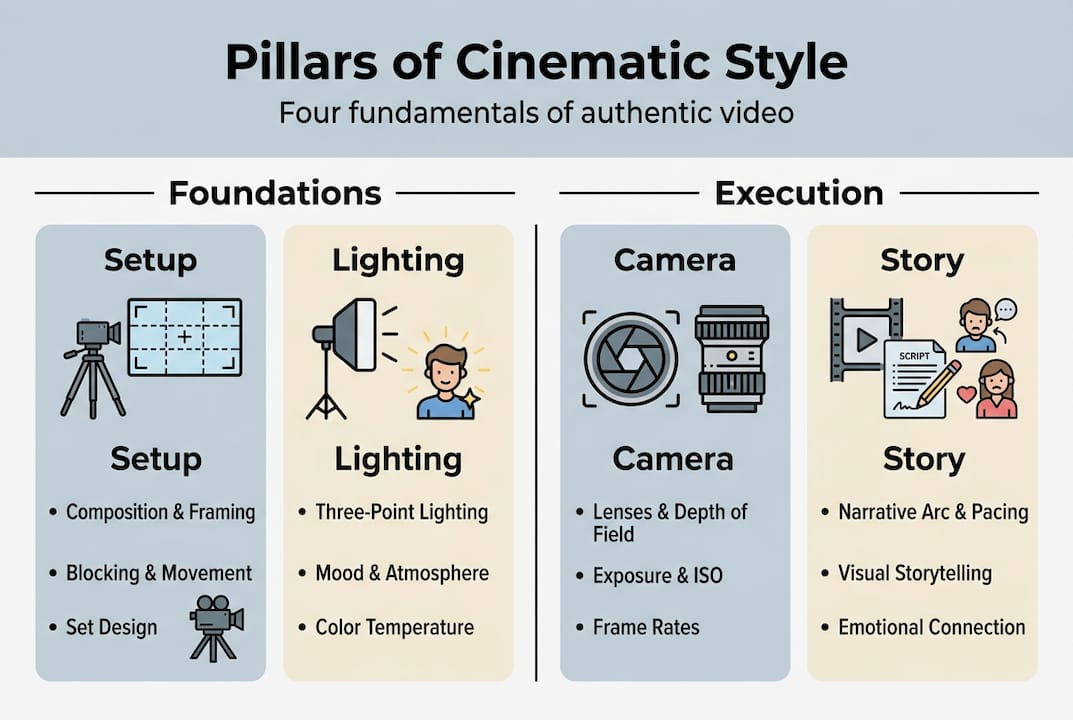
Pillar | Definition | Real-world application |
Setup | The physical arrangement of scene elements, props, and actors | Location scouting, set design, wardrobe choices |
Event | The action, performance, or narrative moment being captured | Directing talent, scripting movement, timing sequences |
Lighting | The quality, direction, and color of light in the frame | Natural light management, artificial lighting rigs, reflectors |
Camera | Lens choice, movement, angle, and frame rate decisions | Shot lists, camera rigs, focal length selection |
These four pillars interact constantly. A strong Setup with poor Lighting undermines the entire shot. Excellent Camera work cannot save a weak Event. The pillars are interdependent, and the best cinematic results come from balancing all four with equal intentionality.
Here is a practical process for balancing technical and creative priorities when planning your next video:
Define the story first. Before any gear is selected, write a clear creative brief that identifies the emotional outcome you want from the audience.
Scout and design the Setup. Visit locations with your director or cinematographer and assess how the environment supports your story.
Plan the Event in detail. Script or storyboard every key moment, including talent movement and timing.
Design the Lighting. Map out natural light conditions at your shoot time and plan artificial supplements accordingly.
Build the Camera plan last. Once the other three pillars are solid, choose lenses, angles, and movements that enhance what is already there.
For cinematic event storytelling, this sequence is especially important because live moments cannot be re-staged. A solid video storytelling workflow that locks in these decisions early saves time and budget.
Pro Tip: Swiss brands often underestimate the value of pre-production lighting design. Spending two extra hours on lighting planning before a shoot can dramatically reduce post-production time and produce a more consistent, authentic visual result.
Avoiding the shallow ‘cinematic’ trap: What NOT to do
Even with a strong framework, knowing which shortcuts to avoid can prevent expensive creative detours. The cinematic aesthetic has become so popular that a whole industry of shortcuts has emerged around it. Most of them look convincing in a thumbnail and fall apart the moment a viewer watches more than ten seconds.
“When everything is shallow focus, nothing has meaning. You lose the ability to use depth as a storytelling tool.” — Ed Lachman, ASC
The shallow depth of field trend is perhaps the most overused shortcut. When every shot has a blurred background, the technique loses its communicative power. Shallow focus is a tool, not a style. The same applies to LUTs. As why LUTs alone fail explains, a color preset cannot create the tonal relationships that come from properly lit and exposed footage.
Shallow technique | Why it fails | Foundational alternative |
Heavy LUT application | Masks poor exposure; creates inconsistency | Correct exposure and white balance on set |
Constant shallow DoF | Removes environmental context | Use depth selectively to guide attention |
Artificial film grain | Looks like noise, not texture | Shoot in low-contrast natural light |
Over-edited color grades | Distracts from story | Match grade to emotional tone of content |
Here are the most common traps to avoid in your next production:
Over-editing in post. If you are spending more time color grading than you did lighting the scene, something went wrong on set.
Ignoring story context. A cinematic shot that does not serve the narrative is just decoration. Every frame should earn its place.
Chasing trending aesthetics. What looks cinematic on social media today will look dated in six months. Build a style that reflects your brand values.
Skipping the shot list. Improvising camera angles on set leads to inconsistent footage that cannot be saved in editing.
For practical storytelling tips that keep your content grounded, and for guidance on lighting fixes when on-set conditions are imperfect, building your team’s foundational skills is always the better investment.
Building your brand’s cinematic signature: Practical steps
Having learned what to avoid, let’s shift to building an authentic and repeatable cinematic identity for your brand. A cinematic signature is not a single video. It is a consistent visual language that audiences recognize across every piece of content you produce.
Research confirms that human evaluation excels in assessing event execution and camera control, areas where automated models still struggle. This matters for your team: the creative judgment of experienced collaborators cannot be replaced by templates or presets.
Here is a sequential process for defining your brand’s cinematic style:
Run a creative strategy session. Involve your marketing lead, brand manager, and a trusted production partner. Define three to five visual values that represent your brand.
Build a mood board. Collect reference images, film stills, and color palettes that reflect those values. This becomes your visual brief for every shoot.
Execute a pilot production. Shoot a short piece using the four-pillar framework and your mood board as guides.
Evaluate with your audience. Share the content and collect structured feedback. Measure engagement metrics alongside qualitative responses.
Refine and document. Update your visual guidelines based on what worked and create a repeatable production checklist.
For Swiss brands, local culture and landscape offer a genuine competitive advantage. Authentic Swiss environments, light conditions, and cultural nuances add a layer of credibility that no international preset can replicate. When choosing a filming partner, prioritize teams who understand your local context and can translate it into cinematic language.
Pro Tip: Develop a brand-specific mood board before every campaign, not just once. Audiences evolve, and your visual language should reflect that growth while staying true to your core creative values.
Why most brands miss the mark: Our take on cinematic style
After these practical strategies, it’s worth pausing to reflect on a lesson many marketers overlook. At Tulip Films, we see the same pattern repeatedly: a brand invests in a video, the team spends the budget on post-production effects, and the result looks polished but feels hollow. Audiences notice. They may not be able to articulate why a video feels inauthentic, but they disengage quickly.
The uncomfortable truth is that cinematic style cannot be downloaded. It is not in a preset pack or a plugin bundle. It lives in the decisions a director makes when walking a location for the first time, in the way a gaffer shapes light around a subject, and in the patience of a cinematographer who waits for the right moment rather than manufacturing one.
Many Swiss brands waste significant time and budget chasing international trends that have no connection to their actual audience or market context. Real impact comes from investing in craft, story context, and the local nuances that make your brand genuinely yours. For your next campaign, reset your team’s starting point: begin with story, then build the visual language around it. Explore video marketing insights to understand how production decisions connect to measurable audience outcomes.
Enhance your brand with expert cinematic production
If you’re ready to take your cinematic ambitions further or need specialized collaboration, here’s where to start. Defining a cinematic signature takes more than good intentions. It takes experienced creative partners who understand both the technical craft and the strategic goals behind your content.
[
Tulip Films brings Swiss-based expertise and a proven production process to every project, from corporate videos to event coverage and brand campaigns. Our team works with you from the first creative brief through final delivery, ensuring that every pillar of your cinematic style is built with intention. Explore our creative video production services, browse our brand video portfolio for real examples of cinematic storytelling, and review our video production pricing to find the right fit for your next campaign.
Frequently asked questions
What is the single most important factor in defining a cinematic video style?
Lighting and environment integration are most critical according to industry experts, far outweighing post-production effects. Getting these right on set is the foundation of any genuinely cinematic result.
How can Swiss brands make their videos stand out cinematically?
Focus on telling authentic local stories, mastering lighting, and collaborating with Swiss-based production teams for real-world context. Human evaluation outperforms AI in capturing unique events and camera nuance, which means experienced local collaborators add irreplaceable value.
Why should marketers avoid heavy reliance on LUTs for cinematic videos?
LUTs can only simulate a look; genuine cinematic style relies on decisions made during capture. Capture-time decisions define authenticity in ways that post-processing simply cannot replicate.
What is an easy first step to start improving cinematic style without more gear?
Plan your scene lighting in advance and adjust the physical environment before filming. Lighting is a critical pillar for cinematic video, and thoughtful pre-production planning delivers immediate improvements without any additional equipment.
Recommended
